Medical AestheticsGive the razor away, keep the blade.
Medical Aesthetics
Give the razor away, keep the blade.
A non-surgical face-lift now arrives as a transaction repeated thousands of times a day across an installed base of more than 35,000 devices: a clinician traces an ultrasound or radiofrequency wand across a jaw, a single-use cartridge counts down its shots, and a cash-paying patient walks out an hour later. That is the energy-based aesthetic-device market — roughly US$6bn today and projected toward US$15bn by 2030 on the broad category measure, though the HIFU/RF skin-tightening slice most relevant here is smaller and slower (nearer US$3.4bn by 2030). Its defining feature is not the machines. It is the consumables they burn. This is a study of how a hardware market quietly became an annuity market, why the firms that missed that turn were punished for it, and what the Korean makers now running the category got right.
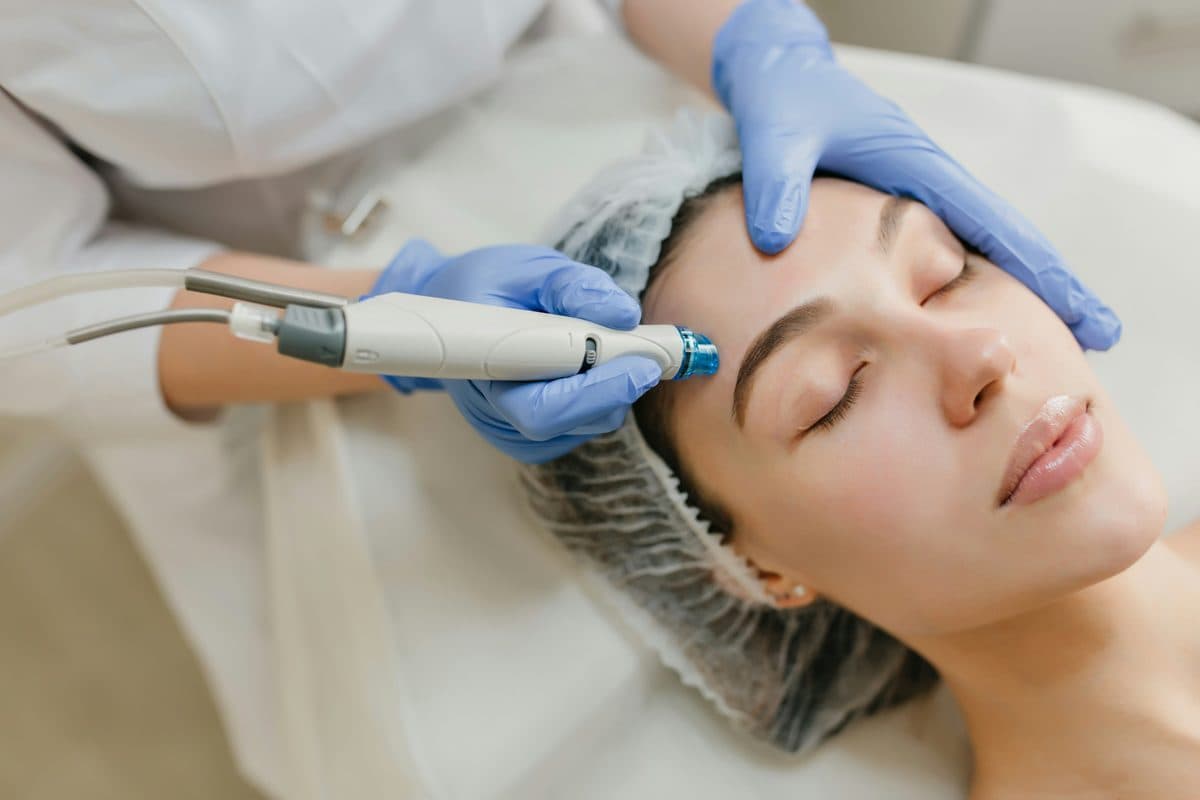
An energy-based skin-tightening treatment in progress. Multiplied across more than 35,000 clinics worldwide, a single procedure like this is what turns a one-time machine sale into a recurring business.
A non-surgical face-lift is no longer a single event. It is a subscription that nobody calls one. A patient who wants tighter skin without a scalpel walks into a dermatology clinic, lies down, and a clinician runs a wand across the jaw and cheeks while a machine fires focused ultrasound or radiofrequency beneath the surface. The session lasts under an hour, costs the patient somewhere between US$1,800 and US$4,000, and consumes a single-use cartridge metered in 'shots.' When the cartridge is spent, the clinic buys another. Multiply that across an installed base north of 35,000 devices worldwide and the energy-based aesthetic-device business stops looking like a hardware market and starts looking like something stranger and far more durable.
The headline number is real but, on its own, misleading. The global energy-based aesthetic device (EBD) market was worth roughly US$6.4bn in 2023 and is forecast to reach somewhere near US$15bn by 2030, growing at about 14% a year. North America is the largest single region and Asia-Pacific the fastest-growing. Those figures describe machines and the procedures they enable. But the most instructive fact in this market is not how big it is. It is where, inside it, the money actually accrues — and the answer is almost never the box on the cart.
Global energy-based aesthetic device market — 2030 forecast (a direction, not a point)
≈US$15bn
Up from ~US$6.4bn in 2023 at ~14% CAGR (Grand View Research). Independent estimates cluster at roughly US$14.4–16.5bn by 2030 (PS Market Research ~US$14.4bn at 13%; Mordor ~US$16.5bn at 14.4%). The trajectory is agreed; the decimal is not. North America is the largest region; APAC the fastest-growing.
How the market is built: four hands the money passes through
We use cookies to understand how our site is used so we can improve it. Necessary cookies are always on. You can accept all, reject all, or choose what to allow. Learn more
The value chain is short and the margin distribution along it is lopsided. A device maker — overwhelmingly Korean — designs and builds the platform. A distributor or direct sales force places it into a clinic, which is the market's capital buyer. The clinic then sells treatments to cash-pay patients. Each link adds cost, but only two of them capture durable economics, and they capture different things. The clinic owns the treatment economics: one cartridge that delivers up to roughly 30,000 shots, against the 400-to-600 shots a full-face session burns, underwrites dozens of sessions priced in the thousands. That is the clinic's spread. The maker's economics are different in kind.
The machine itself is sold thin on purpose. A platform list-priced around US$25,000-to-US$40,000 is the entry ticket, not the prize — and makers routinely seed new clinics with free cartridge vouchers to start the habit. The prize is the re-order. Every cartridge sells at consumable margins, arrives whether or not the clinic is in the mood to buy new hardware this quarter, and scales with how many machines are out in the field. In the language of razors and blades, the handle is a loss-leader and the blade is the business. The whole flywheel is the installed base: the more platforms placed, the larger the recurring cartridge stream pulling through behind them.
The structure underneath the entire market, drawn in 1901: give the handle away, keep the blade. In energy-based aesthetics the 'handle' is a US$25,000-plus machine sold thin, and the 'blade' is the single-use cartridge every treatment consumes for years afterward.
What is pulling demand — and why a new pool of patients just appeared
Three currents feed the category, and none looks transient. The first is the structural shift from surgery to what the trade now calls 'tweakments' — minimally invasive, no-downtime procedures done on a lunch break and posted the same afternoon. Non-surgical procedures reached 20.5 million in 2024, exceeding surgical ones by more than three million, with ISAPS reporting total procedures up roughly 40% against 2020. Filler use in the US alone doubled from 2.6 million people in 2017 to over 5.2 million in 2023. Non-surgical skin tightening now ranks among the top five non-surgical procedures globally.
The second current is newer and, for this category, almost custom-built. The weight-loss drug wave has created a pool of patients that did not exist five years ago. Roughly 12% of US adults — more than 30 million people — have used a GLP-1 medication (RAND, Gallup, 2025), and rapid weight loss frequently leaves the loose, deflated skin the tabloids call 'Ozempic face.' American plastic surgeons reported seeing over 837,000 GLP-1 patients in 2024; about one in four expect the drugs to drive demand for non-surgical tightening and fillers specifically. The figure most worth dwelling on is a behavioral one: a McKinsey reading cited in the original work on this category found roughly 63% of GLP-1 users seeking aesthetic treatment had never been aesthetic customers before — net-new demand, not churn. (That figure originates in the prior article and is carried here as reported, not re-verified to source.)
The third current is geographic. Korea is the category's research lab and its export engine. Energy-based devices account for an estimated 63% of Korea's own domestic aesthetic market — a figure carried from earlier work and not re-verified to a primary source — the country manufactures something on the order of 70% of the world's HIFU equipment, and foreign medical-tourism patients hit a record near two million in 2025. The country writes the playbook and then ships it: the leading makers earn the majority of their revenue abroad, across 80-plus countries.
The 2030 outlook — and an honest note on the spread
Forecasting this market requires admitting how much the answer depends on where you draw the lines. The relevant sub-segment for HIFU and RF skin tightening is smaller and slower than the EBD market that contains it. The cleanest defensible read puts non-surgical skin tightening near US$3.4bn by 2030 at about a 10.6% CAGR. But the published estimates diverge widely because the category boundary is contested: depending on scope, 'today' is sized anywhere from roughly US$1.0bn to US$3.3bn, 2030 estimates run from about US$2.0bn to US$7.1bn, and cited growth rates span 6.4% to 14.3%. Anyone quoting a single precise number for this sub-segment is hiding the definitional argument underneath it.
Scope
Near-term size
2030–34 estimate
Cited CAGR
Skin tightening (defensible anchor)
—
~US$3.4bn by 2030
~10.6%
Non-surgical skin tightening (wide read)
~US$3.2bn (2024)
~US$10.7–12.3bn by 2034
12.8–14.3%
Non-surgical skin tightening (conservative read; cells are different sources)
~US$2.8bn (2023, separate source)
~US$2.0bn by 2030 (separate source)
~6.4%
Broader EBD market (for contrast)
~US$6.4bn (2023)
~US$15bn by 2030
~14.2%
Published forecasts for non-surgical skin tightening (HIFU + RF) diverge by definition, not by error — the boundary between 'skin tightening,' 'body contouring' and the broader EBD market is drawn differently by each house. All figures approximate; ranges, not points. Note: within a row the near-term and 2030 cells can come from different houses and define the category differently — in the conservative row especially, the ~US$2.8bn (2023) and ~US$2.0bn by 2030 figures are separate sources at different scopes, so they do not describe a single shrinking series. Sources: Research and Markets; Precedence Research; PS Market Research; Mordor Intelligence; Grand View Research.
Buried in that table is the tension worth naming. Skin tightening's ~10.6% anchor CAGR trails the broader EBD market's ~14%. The reason is structural: radiofrequency is the largest and most crowded sub-segment, and it is commoditizing fastest. RF generators are easier to build and copy than focused-ultrasound transducers, so a flood of competing platforms drags the blended growth of the skin-tightening segment below that of the device market it sits inside. Growth is real; it is simply uneven, and the easy part of the technology is where the price competition concentrates.
The structural fact: a hardware market that quietly became an annuity market
Step back and the central shift in this market over the past decade is not a technology or a region. It is a business model that bifurcated the field. Two ways to sell an energy-based device emerged. One sells the machine and hopes the clinic buys the next one — a classic capital-equipment cycle, exposed to whether clinics feel like spending on hardware in any given year. The other gives the machine away cheap and gets paid every time it is used, through a proprietary cartridge the clinic cannot avoid re-ordering. Both look like 'aesthetic device makers' from the outside. Underneath, one is a hardware business and the other is an annuity. The difference only becomes visible when hardware demand stalls — and in 2024 and 2025, in the United States, it did.
The competitive structure: a Korean cohort, a Western incumbency, and a shrinking moat
The market sorts into recognizable archetypes, and the dividing line between them is recurring mix. A Korean trio — CLASSYS, Wontech and Jeisys — now dominates production and is export-led, racing each other in both HIFU and RF (Shurink and Ultraformer against Volnewmer, Density and the rest). Western incumbents — Merz with Ultherapy, InMode, Cutera, Venus Concept — hold brand recognition and clinical reputation but carry a shallower consumable mix and heavier exposure to US clinic capital spending. And cutting across all of them is a commoditizing edge: RF platforms are proliferating, and grey-market and counterfeit cartridges are beginning to test whether the 'blade' stays proprietary at all.
The consumable-led exporter (Korean trio). CLASSYS at ₩336.8bn for FY2025 (+38.6%, ~66% overseas), Wontech at ₩156.8bn (+36.1%), Jeisys at ₩143bn with ₩121bn — roughly 85% — earned abroad. Built on a deep cartridge re-order stream off a large installed base.
The Western brand incumbent. Merz (Ultherapy), InMode and Venus Concept hold reputation and clinical data, but a machine-heavy mix leaves earnings tied to the US hardware purchasing cycle.
The single-bet hardware maker. The most exposed posture in the market — a narrow product line funded for growth, with little recurring revenue to cushion a stall. This is the box Cutera occupied.
The grey-market threat. Counterfeit and copy cartridges that attack the proprietary-blade economics directly, concentrated in the fastest-commoditizing RF tier.
These are revenue figures, company-reported for the latest disclosed fiscal year, and they sketch a market where the same end-demand currents lift everyone — but where the model determines who keeps the gains when demand turns choppy. The clearest way to see that is to set the consumable-led case against the machine-led ones directly.
The case in point: the company that sells the blade, not the box
CLASSYS, from Seoul, is the cleanest worked example of the annuity model in this market — not because it is the largest device maker in the world, but because its economics make the structural argument legible. It places focused-ultrasound and radiofrequency platforms into clinics at deliberately keen prices, then earns year after year on the single-use cartridges every treatment consumes. By 2025 that recurring stream had grown to roughly 46% of revenue (company-reported) and was compounding nearly as fast as the device line. Almost half the business is sticky, high-margin re-orders that arrive independent of any clinic's hardware-buying mood — and the installed base that drives them, described in the FY2025 disclosure as north of 35,000 platforms and in the April 2026 IR release as 45,000-plus, is the asset; the cartridge re-order is the realized return.
The consumable mix, not the machine count, is the point
≈46%
Share of CLASSYS FY2025 revenue from consumables (cartridges and tips), company-reported. The installed base is a moving figure: 35,000-plus platforms per the FY2025 disclosure, 45,000-plus per the April 2026 IR release (Ultraformer 21,000+, Volnewmer 3,300+). Both are defensible at their dates.
What that structure produces is the anomaly: a company that grows like a device maker yet earns like an annuity. Between 2021 and 2025, CLASSYS roughly tripled revenue while its operating margin stayed pinned in a narrow band around 50% — 50.7% in FY2025 on ₩336.8bn (these FY2025 figures trace to DART consolidated statements). Growth and fat margins normally trade off; here the trade did not happen, because each new machine placed anywhere in the world enlarged the cartridge base re-ordering behind it at the same high margin. (The company's April 2026 guidance — roughly ₩490bn of 2026 revenue, ~45% growth, operating margin 'exceeding 50%' — is management's own framing and is not auditor-certified; treat it as IR rather than audited.)
The argument is best proven in reverse, by the firms that sold the box without the blade. InMode — US-Israeli, with brand, technology and a strong balance sheet — ran a mix of roughly 78% machine and 22% consumable. When American clinics stopped buying equipment through 2024 and 2025, there was almost no recurring revenue to break the fall: sales slid from a peak near US$492m toward US$370m and operating margin roughly halved from a 46.8% peak to about 23%. Cutera went further down the same road, betting the company on a single new device funded with debt; when growth stalled, margins collapsed and it filed for Chapter 11 in March 2025. 'Aesthetic device maker' was never, by itself, a quality business. The quality lived in the blade.
Energy-device maker
Revenue
Op. margin
Recurring mix
Through the 2024–25 hardware slowdown
CLASSYS
₩337bn
50.7%
~46%
Kept growing; margin held ~50%
InMode
~$370m
23.0%
~22%
Sales fell from ~$492m; margin halved
Cutera
$212m
−74%
Thin
Chapter 11 filed, March 2025
The same demand, three outcomes — sorted by recurring mix. Latest disclosed fiscal year, company-reported / regulatory filings (DART for CLASSYS; SEC filings for InMode and Cutera). The two makers with a shallow consumable mix had nothing to cushion the 2024–25 US hardware slowdown; the consumable-led maker kept compounding through it.
Every procedure here is elective and paid in cash, so clinic hardware budgets are the first thing to flex when sentiment turns. The recurring cartridge stream behind the procedure — not the machine on the cart — is the part of the market that holds up when clinics tighten their belts.
The open risk: regulation, trade, and whether the blade stays proprietary
Two forces will shape the next phase, and both sit outside any single company's control. The first is regulatory access. These devices require CE marking, FDA clearance and regional approval — MFDS in Korea, PMDA in Japan, and critically NMPA in China, the largest untapped market for the category. CLASSYS describes its China entry as 'expected to complete' (April 2026 IR) — prospective, not done — and that approval is the single clearest open catalyst for the Korean cohort. The second force is counterfeiting, and it strikes at the model's foundation. Copy cartridges and fake units attack the proprietary-blade economics directly. China is the source of more than 70% of the world's counterfeit goods (OECD / US Customs framing); the cartridge-specific share is illustrative rather than a cited figure, but counterfeit Ultherapy and Ultraformer units are documented in circulation, some traced back to Korea, carrying real patient-safety risk and eroding the moat that makes the annuity an annuity.
Gangnam, Seoul — the clinic cluster that made Korea the global proving ground for non-surgical aesthetics, and the home base from which the Korean makers export to 80-plus countries. The category's next leg of growth turns on regulatory access to markets like China, not on new demand at home.
Where the market goes from here
Project the category forward and two things happen together. Demand keeps compounding — toward roughly US$3.4bn for skin tightening by 2030 on the defensible anchor, inside an EBD market heading for US$15bn — while the field sorts by model rather than by brand. The makers with a deep, defensible consumable stream convert end-demand growth into durable earnings; the machine-led players ride the clinic capital cycle up and down; and the commoditizing RF tier compresses margins for everyone exposed to it. The reliable part of the forecast is the direction of demand. The variable part is who captures it, and that is decided by recurring mix and the durability of the blade — not by the size of the installed base alone.
Path
What would have to be true in the market
What the maker must execute
The annuity compounds
China and other approvals land; counterfeits stay contained; the consumable mix holds or deepens.
Defend cartridge proprietary-ness; convert new approvals into installed-base growth.
A durable specialist
Demand grows but RF commoditization and grey-market copies cap the recurring premium.
Hold margin through product differentiation; protect the existing base's re-order rate.
The moat erodes
Copy cartridges spread faster than enforcement; the blade stops being reliably proprietary.
Re-anchor value in the next platform cycle before the annuity thins.
Illustrative market-and-capability scenarios for the consumable-led model — analytical constructs to frame the question, not forecasts of record. Each is defined by what happens in the market and what a maker must execute, anchored to the cohort's demonstrated growth and the 2025–2030 regulatory and trade environment.
“In any market that looks like a 'device' sale, the box is the cover story. The durable economics hide in the consumable — and the only questions that matter are how large the installed base is, and how reliably it re-orders the maker's own blade rather than someone else's copy.”
— Nathan Research Group, Medical Aesthetics Series N°08
The lesson, and where it travels
The rule generalizes well past one Korean company and well past aesthetics. Wherever a market is built on a 'device' sale — dialysis, coffee pods, printers, surgical staplers, at-home beauty gadgets — the headline machine is rarely where value lives. It lives in the consumable, and a market that sizes itself by units shipped is measuring the wrong thing. Energy-based aesthetics is simply the clearest current laboratory for the principle, because it ran the experiment in both directions at once: the makers that sold the blade compounded through a hardware downturn that halved one rival and bankrupted another. The most revealing question to ask of any such market is not how many machines were sold. It is how big the installed base is, how reliably it re-orders, and whether the blade stays proprietary when the copies arrive. Our full brief on the energy-based aesthetic-device market — the sizing, the value-chain economics, the competitive map, and the regulatory and counterfeit outlook — is available to download with this article.
Working With Nathan Research Group
Partner With Nathan Research Group
Filings disclose the consumables percentage and the installed-base count; they cannot tell you whether a clinic actually re-orders the maker's own cartridges or quietly switches to a grey-market copy, how fast counterfeit cartridges are spreading through a given export market, or what the China-approval timeline really looks like on the ground. Those answers live with the clinicians, distributors and former operators who run these devices every day — and reaching them, compliantly, is what we do.
Korea’s first dedicated expert network — Seoul, since 2013
Who we put in the room
Former executives & founders
CLASSYS and its domestic and global energy-based-device peers.
R&D & hardware engineers
HIFU transducer, RF generator, and cartridge and tip design.
Clinicians & key opinion leaders
Dermatologists and plastic surgeons who own and run the devices.
Distributors & channel partners
Korea and the export markets — Brazil, Japan, CIS, Thailand and Taiwan.
High-volume buyers who can speak to real consumable pull-through.
Suppliers, competitors & specialists
Including MFDS, NMPA, FDA and PMDA regulatory and reimbursement experts.
How an engagement works
1Scope
We turn your thesis into a precise expert profile and question set, mapped to the decisions you need to close.
2Source & vet
We screen and compliance-clear each expert — relevance, recency, and the absence of conflicts — before any call.
3Convene & synthesize
We arrange interviews on your timeline and, where useful, deliver written synthesis tied back to your questions.
If your team is evaluating CLASSYS, the energy-based aesthetic-device sector (HIFU / RF), or the broader Korean medical-aesthetics supply chain, tell us the decision you’re trying to make.
A direct reply from a partner, not an intake form.
Based solely on public sources. Nathan Research Group does not request or facilitate material non-public information, and runs every engagement through a documented compliance protocol.