ShipbuildingA 65% surge, and a price that moved 0.45%.
Shipbuilding
A 65% surge, and a price that moved 0.45%.
Global new orders ran 50.93m CGT in the first seven months of 2026, up 65% year on year across 1,778 hulls. The newbuilding price index moved 0.45% over the same stretch. That gap is this market's central fact, and it follows from the unit actually being sold: a dock-year, a reserved position in a build programme three to four years out. Korean delivery slots are booked through 2028, and by mid-year the yards were quoting the first half of 2030. They did not add docks. They extended the queue. No valuation and no price target.
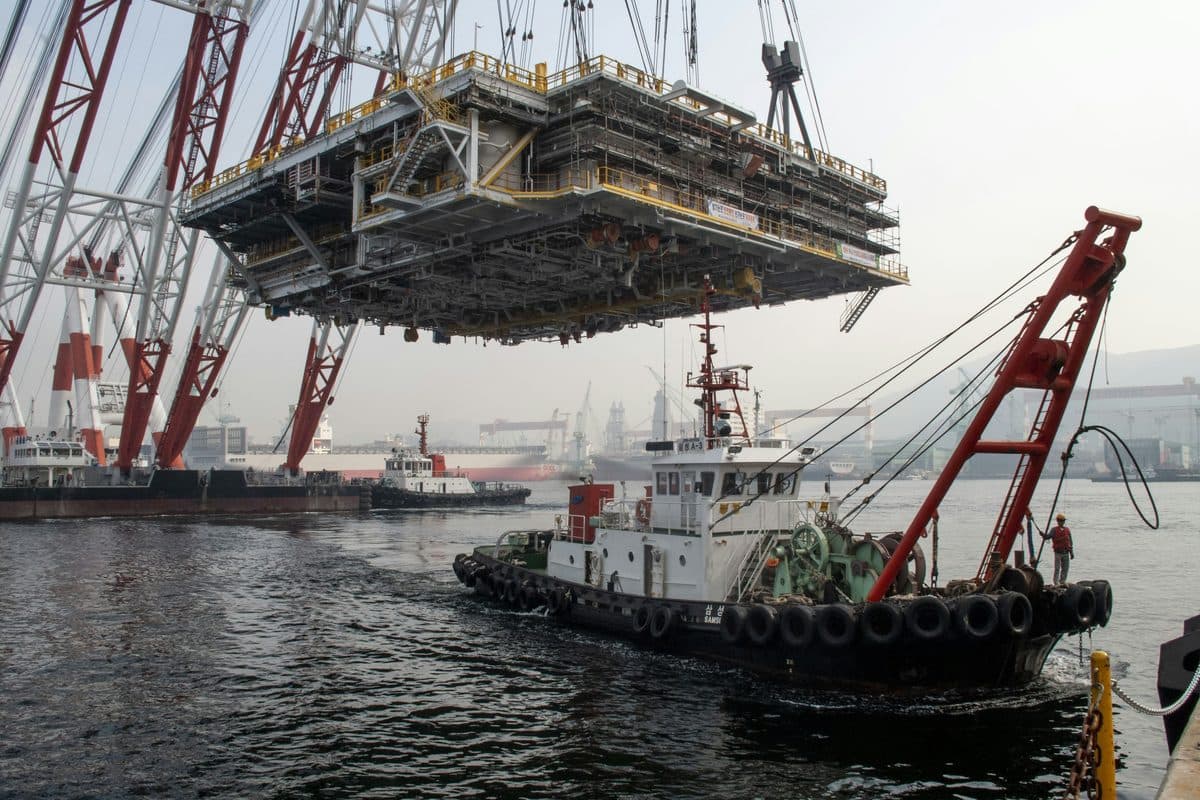
A completed block under a floating crane. What a yard sells is the sequence this object sits inside — a reserved position in a build programme, three to four years out, counted in compensated gross tonnage.
本研究简报以英文发布。
The unit of trade in shipbuilding is not the ship. It is the dock-year: a reserved position in a build programme, three to four years out, sold before the steel for it exists. Read that way, the figures from the first seven months of 2026 stop looking contradictory. Global new orders came in at 50.93m CGT across 1,778 hulls, 65% ahead of the same seven months a year earlier. The newbuilding price index went from 184.65 at the end of 2025 to 185.49 in July 2026, a move of 0.45% across seven readings. A 65% surge in volume produced almost no move in price, because the scarce thing was never what that index prices.
The surge and the price, on matched cuts. The first two rows compare January–July 2025 with January–July 2026. The index row runs end-2025 to July 2026 across seven readings and is therefore a different window, shown here because it is the comparison the market itself makes. Korea's 17.5% to 17.1% is like-for-like and is not substitutable for the annual series.
Korea's share of those orders reads 17.1%, against 17.5% in the matched seven months of 2025 — which is to say, barely moved. It is worth resisting the temptation to run that against the annual series, where the same measure reads 14.0% for 2024, 21.0% for 2025 and 17.1% for the seven-month 2026 cut. Those are two different readings on two different bases, and the annual one is not a longer version of the seven-month one. The like-for-like comparison says Korea held its position through a 65% market surge. The annual series says something about 2025 that the seven-month cut cannot confirm either way.
The numbers get revised, and they revise upward
A further caution applies to every figure above. Order statistics in this market are restated, and the restatements located all run one way. April 2026's monthly total was revised up 26.0%, to 8.18m CGT. The January-to-April cumulative went up 11.4% to 29.04m CGT, January-to-May up 12.3% to 37.70m CGT, and even 2024's full year was revised up by about 17%, to 76.78m CGT. Anyone reading a fresh monthly print here is reading a provisional number, and every restatement located so far has moved that number up.
The slot book
What the Korean yards have sold, and what is left, is the more useful inventory. Secured backlog runs about 3.5 years. Delivery slots are booked fully through 2028. When 2026 opened, roughly 70 deliverable 2029 positions existed and about 20 were taken, leaving something like fifty uncommitted; by mid-year availability had moved to 2030 and yards were quoting the first half of it. Against an annual construction capacity that analysts — not the yards — put at about 11m CGT, the January-to-July intake annualises to roughly 14.9m CGT [NRG estimate], some 35% above that figure. A market taking orders a third faster than it can build them has to put the difference somewhere, and it puts it in the calendar.
Measure
Reading
Secured backlog
~3.5 years
Delivery slots booked
Fully through 2028
2029 positions uncommitted at the year's open
~50 of ~70 deliverable
Availability quoted by mid-2026
First half of 2030
Annual construction capacity
~11m CGT (analyst estimate)
January–July 2026 intake, annualised
~14.9m CGT [NRG estimate]
The Korean slot book. Slot figures come from a Korean securities-analyst compilation via iMarine, 2026-01-04; the mid-year availability shift from Seoul Economic Daily, 2026-07-18. Capacity is an analyst estimate and explicitly not a yard disclosure. The annualised intake is 8.70m CGT scaled from seven months to twelve. No located source quotes a Korean delivery beyond the first half of 2030.
Draft marks on a finished hull. Two credible tallies of this market rarely agree, because they are not counting in the same unit.
Two dock movements, both modest
An order surge of this size would normally pull capacity in behind it. In Korea it has not, or not yet. The two dock movements on the record are modest and largely internal. Yeongdo is a single 300m dock at HJ Shipbuilding's existing yard, which confines it to mid-size merchant hulls and naval special-purpose vessels. Gunsan is the larger one, about 700m and designed for ten to twelve ships a year, and HJ Shipbuilding's largest shareholder is in due diligence to acquire it. Should that go through, it moves an existing dock between two Korean companies; either way it adds nothing to national capacity. Meanwhile more than half of the orders placed in 2026 are already scheduled to deliver after 2028. The yards are not adding docks. They are extending the queue.
An empty graving dock. The binding constraint in this market is the number of these and how many years of each are already spoken for — which is why moving one between two owners changes less than it appears to.
Where scarcity does carry a price
If the newbuilding index will not price a shortage, something else has to. The resale market does. A VLCC changing hands second-hand has cleared at roughly US$40m above a newbuild, about 30% — the cost of not waiting, paid by a buyer who wants a hull now instead of a position in 2030. Input costs move on their own schedule. Korean plate rose ₩50,000 a tonne on the distribution channel from April 2026, one maker first with a second expected to follow, while the benchmark the yards themselves negotiate was still unsettled. A hull priced years ago absorbs that difference out of its own margin.
VLCC resale premium over a newbuild
~US$40m
About 30% over a newbuild. Scarcity shows up here as a price; everywhere else in this market it shows up as a date.
“An instrument that reserves dock time three to four years out, counted in five units by two families of house that measure the same hull three to four years apart, with a queue that lengthens instead of a price that rises, and a constraint that sits one layer upstream of the dock.”
— Nathan Research Group, Korea Market Series N° 03
That last clause is the one to carry away. The layer upstream of the dock is where the real contest sits: the marine engine makers whose order books outgrew the yards they supply, and the membrane containment licence for which no Korean substitute has yet been qualified. Five questions outlast the public record. How much of the two engine makers' 2026 intake is Chinese, and how long it stays. What a Korean containment substitute costs to qualify, and by when. Whether the announced Philadelphia spend becomes actual dock, and on what schedule. Whether the national 2029 and 2030 slot inventory, which rests on one compilation from January, still holds. And what it would take to move an index that did not move under a 65% volume surge. Every one of the five sits with a person: a yard planner, an engine sales desk, a broker who struck the price. Our full 27-page study — the order statistics and their restatements, the slot book, the two dock movements and the layer upstream of both — is available to download with this article.
与 NRG 合作的方式
与 Nathan Research Group 合作。
Published sources establish the shape of this market. They do not settle what a diligence outcome turns on — which delivery year a yard is quoting this month, how much of an engine maker's book is Chinese and how long it stays, what qualifying a domestic containment substitute costs and by when, or what sits in the contract behind a headline newbuilding price. Every one of those answers moves before a statistic does. Reaching the people who hold them, compliantly, is what we do.
韩国首家专家网络 — 首尔,2013年至今
我们会请谁到场
Yard planners and dock schedulers
Slot release, delivery-year sequencing, and what a quoted window is actually worth to the party holding it.
Marine engine and propulsion sales
The layer that outgrew the yards it supplies, how durable that demand is, and what happens as Chinese engine capacity catches up.
Cargo containment and LNG engineers
Membrane licences, the royalty they carry, and what a qualified domestic substitute would take in cost and calendar time.
Shipbuilding plate buyers
The twice-yearly reset, the gap between distribution pricing and the yard-negotiated benchmark, and what a plate move does to a hull already priced.