K-BeautyThe scarce layer is the one that publishes least.
K-Beauty
The scarce layer is the one that publishes least.
Korean factories made ₩17.94tn of cosmetics in 2025, and the export line ran a record US$7.0bn in the first half of 2026, up 27.3%. Read as one number, that is a growth market. It is two. The cosmetics leg is a manufacturing layer of 4,158 registered factories serving 28,412 registered brand owners — 6.8 brands per factory [NRG estimate] — where contract-manufacturing margins ran 8.2% at Cosmax for the 2025 financial year and 14.2% at Cosmecca Korea in the second quarter of 2026. Beside it sits medical aesthetics, which sells the same consumer a procedure instead of a product, and where Classys reported 50.7% for 2025. Same consumer, different regulator. No valuation and no price target.
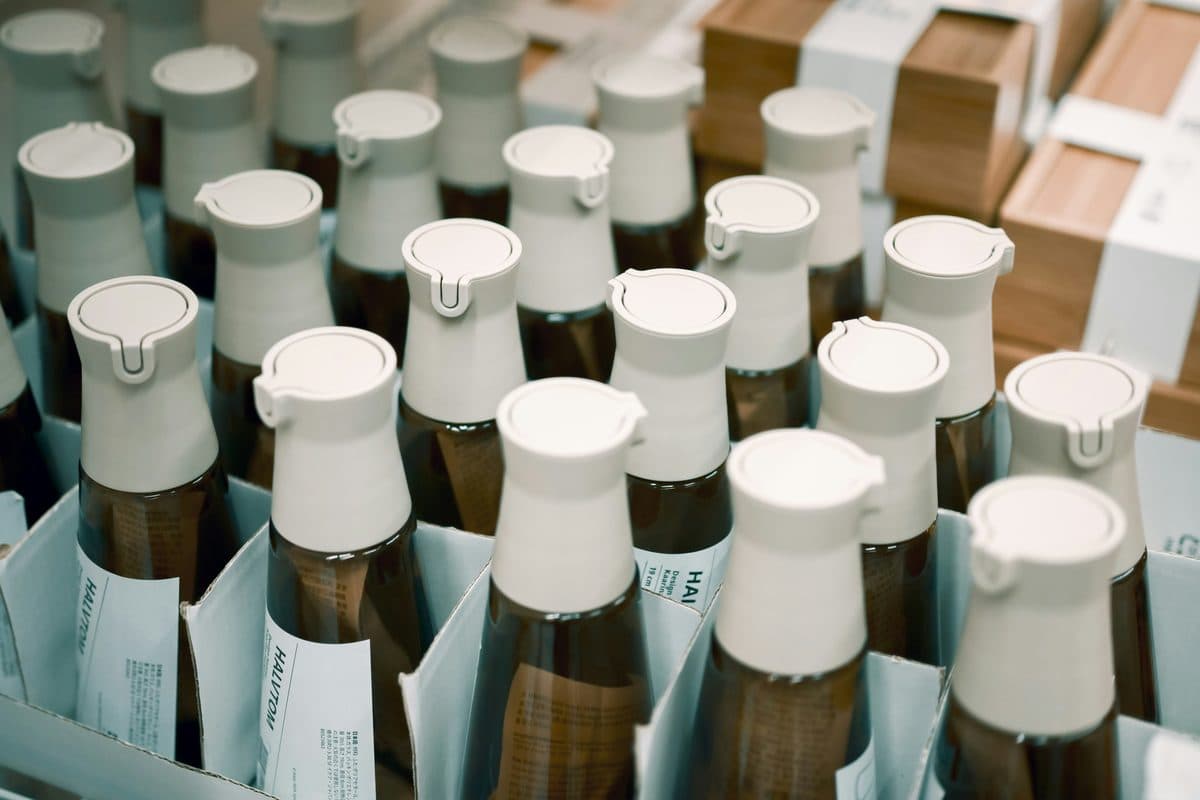
Finished units in shipping dividers. Capacity, customer count, price per finished unit: no manufacturer in this market publishes any of the three.
本研究简报以英文发布。
Korean factories produced ₩17.94tn of cosmetics in 2025, up 2.3% on the year, and the export line ran US$7.0bn in the first half of 2026, up 27.3% — a record half. Read as one number, that is a growth market. It is not one market. It is one demand market sitting on two supply markets, which meet at the consumer and at the retail gate and then separate at the factory, the regulator and the margin. One of them sells a product. The other sells the same consumer a procedure.
What gets quoted as the size of this market is not one number. One reading here is production, on a manufacturer basis from Ministry of Food and Drug Safety statistics; the other four are export readings on a Korea Customs Service basis, one covering a full year and three covering the first half of 2026. They are not additive, and none of them substitutes for another.
Where the demand went
The destination mix has inverted inside four years. China took 46.5% of Korea's cosmetics exports in the first half of 2022. In the first half of 2026 it took 14.4%. Those are five readings on one half-year basis through a single agency chain — one collection method the whole way. Over the same stretch the United States crossed 20% of the export line for the first time — US$1.45bn and 20.7% in the first half of 2026, up 41.5%. That growth was recorded against a 15% United States tariff applied to Korean goods including cosmetics from 7 August 2025, and measured off a first-half 2025 base that had no tariff in it at all. The mix diverges by category as well as by destination: basic skincare was 57.5% of what Korean factories made in 2025 and 74.7% of what left the country.
Period
China's share of the export line
1H 2022
46.5%
1H 2023
34.7%
1H 2024
25.2%
1H 2025
19.6%
1H 2026
14.4%
China's share of Korea's cosmetics exports, first half of each year, on Ministry of Food and Drug Safety data via Hankyung, 2026-07-02. All five readings are half-year and share one collection basis. No export-value series exists on these same five periods, so this runs as a table of shares with no level series beside it.
At the counter
The retail gate is where this market stops being a statistic and becomes a transaction, and domestically one chain dominates it: CJ Olive Young turned over ₩5.8334tn in 2025, up 21.8%. What has changed inside that figure is who is standing at the counter. The chain's foreign-customer share of its own offline sales has gone from 2% to 28% in three years — more than a quarter of that floor now sold to buyers who travelled to it rather than being shipped to. That gate is the second of the two joints between the two supply markets; the consumer is the first. Everything past it separates.
Foreign-customer share of CJ Olive Young's offline sales
28% in 2025
Up from 2% in 2022, 11% in 2023 and 21% in 2024. The source rounds to whole points, and the series covers the chain's own offline sales only.
Finishing and packing — the last operation before a unit becomes an export statistic.
The layer that is scarce and cannot price
The first supply market is a manufacturing layer, and it is outnumbered. Korea had 28,412 registered brand owners in 2025 against 4,158 registered manufacturers, or 6.8 brands for every factory [NRG estimate]. The two counts moved in opposite directions in the same year: brand owners up 1.7%, factories down 6.3%. Inside that layer, production is concentrated. Three contract manufacturers — Cosmax, Kolmar Korea and Cosmecca Korea — accounted for 18.2% of national production value [NRG estimate], while the two largest in-house producers held 38.7% and manufacture only for their own brands. That is the chokepoint: a supply layer that is scarce and cannot price.
Measure
Reading
Registered brand owners
28,412, +1.7%
Registered manufacturers
4,158, −6.3%
Brand owners per factory
6.8 [NRG estimate]
Three ODMs' share of national production value
18.2% [NRG estimate]
Two largest in-house producers' share
38.7%
The manufacturing layer, 2025. Brand owners are registered responsible distributors. The 6.8 ratio and the three-ODM production share are our own calculations from the registered counts and published production values. The in-house share belongs to two producers manufacturing only for their own brands.
Formulation at the bench. One leg registers a cosmetic; the other submits a device. The rulebook is where these two supply markets part.
The second supply market
Beside the cosmetics leg sits medical aesthetics, which reaches the same consumer through a different regulator. Its inbound demand is measured directly rather than inferred from a shipment: 618,973 Chinese patients were treated in Korea for medical-aesthetic procedures in 2025, up 137.5% on the year and the largest single inbound nationality. The margin is where the two legs separate hardest. Cosmetics contract manufacturing ran an operating margin of 8.2% at Cosmax for the 2025 financial year and 14.2% at Cosmecca Korea in the second quarter of 2026, both on our own calculation. Classys, on the medical-aesthetics side, reported 50.7% for the 2025 financial year — roughly five times the cosmetics readings, across three companies on two period bases.
Company
Basis
Operating margin
Cosmax — contract manufacturing
FY2025
8.2% [NRG estimate]
Cosmecca Korea — contract manufacturing
2Q 2026
14.2% [NRG estimate]
Classys — medical aesthetics
FY2025
50.7%, company-reported
Operating margin, the two supply markets. The two contract-manufacturing readings are our own calculations and cover different periods — one a financial year, one a single quarter. The medical-aesthetics reading is company-reported for the financial year. Three companies on two period bases: the comparison is of order of magnitude, not of like for like.
“An export market measured by five quantities that cannot be added, supplied by a layer that is scarce and cannot price, reached through intermediaries that did not exist a decade ago, and standing beside a second supply market that sells the same consumer a procedure instead of a product.”
— Nathan Research Group, Korea Market Series N° 05
Where the public record stops, four questions begin. Capacity: no Korean cosmetics contract manufacturer publishes a current figure, and the one tier-one series located stops at the end of 2024, so this market cannot observe its own supply limit. Customer concentration: no manufacturer discloses a customer count, and the single disclosed top-ten share is on a 2024 financial-year basis. Route economics: no source publishes what an aggregator or a distributor takes between a Korean brand and a foreign shelf. And the European gain, where nobody has established whether the Netherlands figure is Dutch consumption or Rotterdam freight. Three of the four wait on someone who knows and has no reason to publish; the fourth waits on a customs code that was never built to answer it. Our full 27-page study — the five quantities and their bases, the manufacturing chokepoint, the retail gate and the second supply market — is available to download with this article.
与 NRG 合作的方式
与 Nathan Research Group 合作。
Published sources establish the shape of this market. They do not settle what a diligence outcome turns on — what a contract manufacturer's line is actually running at, or what an aggregator takes between the brand and the shelf. Neither of those sits in a filing. Reaching the people who can answer them, compliantly, is what we do.
韩国首家专家网络 — 首尔,2013年至今
我们会请谁到场
Former regulator and customs officials
Registration, functional claims, and how the national production and export series are compiled in the first place.
Contract-manufacturing operators
Formulation tiers, line utilisation, and the price per finished unit — the figures no manufacturer in this market currently publishes.
Brand-owner founders and category leads
Supplier selection, category economics, and why a colour-weighted book behaves unlike a skincare one on the same line.
Export aggregators and overseas distributors
The route between a Korean formulation and a foreign retailer, and who takes what along it.