Korea's battery majors enter Q1 2026 in the red — and the JV architecture is unwinding
LG Energy Solution, Samsung SDI, and SK On all reported operating losses in Q1 2026 even with IRA AMPC credits booked. Stellantis is still negotiating its exit from StarPlus Energy. SK On's Nissan Canton deal is at risk. The K-LFP pivot is on track — but the joint-venture architecture that justified the 2022–2024 capex cycle is unwinding faster than the cells can ship.
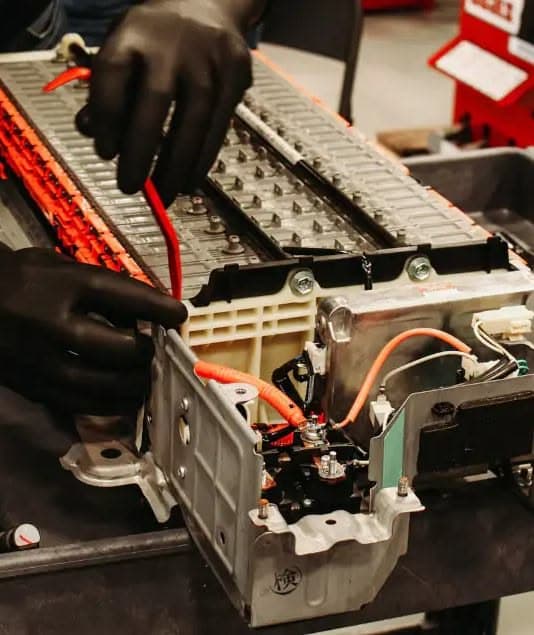
At the 2023 InterBattery conference in Seoul, an LG Energy Solution executive told reporters — on the record — that lithium iron phosphate would remain a 'sub-premium' chemistry for the Korean majors. Three years later, all three Korean cell makers are building dedicated LFP capacity in Korea and the United States. The pivot is visible in the equipment-order data, in FTC filings around the US joint ventures, and in the Q1 2026 earnings calls just released. What is also visible is something the original pivot thesis did not anticipate: every one of the three Korean producers swung to an operating loss in Q1 2026, even before the joint-venture stress is resolved.
Q1 2026 earnings: the reset is real
- LG Energy Solution: revenue ₩6.6T (+1.2% QoQ), operating LOSS of ₩207.8B even after booking ₩189.8B of IRA Section 45X (AMPC) credits. The 46-series cylindrical order book passed 440 GWh; ESS is now roughly 20% of revenue.
- Samsung SDI: revenue ₩3.58T, operating LOSS of ₩155.6B. Battery revenue ₩3.4T (-7% QoQ, +13% YoY). The firm signed a Mercedes-Benz multi-year supply agreement during the quarter.
- SK On: cumulative operating loss since the 2021 spin-off reached ₩3.22T. SK Innovation announced an ₩8T capital-raising plan in March, including a ₩2T third-party rights offering specifically backstopping SK On. The unit cut more than 950 jobs at its US plant the same month.
Korean cell maker operating profit, Q1 2026
All three negative
LGES -₩207.8B (with AMPC) · Samsung SDI -₩155.6B · SK On still loss-making
The IRA / FEOC framework just got tighter
Treasury and IRS Notice 2026-15, issued February 12, provided FEOC guidance under the One Big Beautiful Bill Act (OBBBA). Section 45X manufacturing credits were largely preserved — no accelerated phase-out for cell production — but the rules introduced a new Material Assistance Cost Ratio: cells claiming 45X credits in 2026 must demonstrate at most 60% material assistance from FEOC sources, scaling to 85% by 2030. The Trump administration in parallel eliminated the EV consumer tax credit, removing the demand-side leg of the IRA stool.
Korea's status as a US free-trade-agreement partner means materials processed in Korea continue to qualify under IRA mineral and component thresholds. That regulatory asymmetry is the structural reason Korean cathode specialists — EcoPro, L&F, POSCO Future M — have been able to win US LFP offtake at prices Chinese CATL cannot match inside the IRA perimeter. LG Chem's Morocco LFP cathode JV with a Chinese partner, however, is running directly against the FEOC boundary and will require restructuring to remain credit-eligible.
K-LFP timelines hold, but the demand profile is shifting
LG Energy Solution's Ochang Energy Plant in North Chungcheong Province held its November 2025 ground-breaking on schedule and is committed to 1 GWh of domestic LFP production for energy storage starting in 2027. SK On confirmed it will convert part of its SK Battery America plant in Georgia to LFP production in the second half of 2026, alongside a 3 GWh domestic Seosan LFP line aimed at the Korean utility ESS pipeline. Samsung SDI is retrofitting the StarPlus Energy lines in Indiana — now in joint discussions with GM — for LFP production targeting Q4 2026.
The demand profile underneath these plans has shifted from EV-led to ESS-led faster than the original capex justification anticipated. LGES booked a $4.3 billion Tesla Megapack 3 LFP supply contract in March 2026, and signed a $1.4 billion Mercedes LFP deal targeted at European EV programs. The European pivot is pronounced: a roughly ₩10 trillion BMW cylindrical contract sits alongside the Mercedes deals, while in the US, Ultium Cells (the LGES-GM joint venture) is shutting down some plants through the first half of 2026 against near-zero EV battery sales.
The joint-venture unwind
Stellantis is still in active discussions with Samsung SDI to divest its 49% stake in StarPlus Energy following the February 2026 announcement of roughly €22 billion in EV-related write-downs under CEO Antonio Filosa. Reported options include a Samsung SDI buy-out — potentially funded by the firm's ₩10 trillion Samsung Display divestment — or a third-party sale; no resolution has been announced as of early May. SK On's $10 billion supply deal with Nissan in Canton, Mississippi is at risk after Nissan dropped EV plans for the Canton facility, the Korea Times reported on May 6.
The Korean cell makers' US joint-venture architecture was the operating model that justified the 2022–2024 capex cycle. It is now visibly fragile. The K-LFP pivot does not depend on it, but the depreciation tail of the original NCM joint ventures does — and that is where the Q1 2026 losses are concentrated.
Stellantis-Samsung SDI JV status, May 2026
Unresolved
Stellantis seeking exit · Samsung SDI buy-out or third-party sale on the table
A different margin story — and a different end-market
LFP was dismissed in Seoul because the margin per kWh was a third of premium NCM. That arithmetic held when LFP meant BYD cells sold into Chinese-domestic buses. It does not hold when LFP means IRA-eligible cells sold into Tesla Megapack, US grid-scale ESS, and select Ford / GM / Mercedes mass-market EV programs. Our modelling suggests blended gross margin on Korean-made LFP lands within 4 percentage points of premium NCM by 2027 — provided FEOC rules hold and EV demand recovery in the US extends beyond the current Tesla Model Y monthly imports milestone in Korea (the first imported EV to top 10,000 units a month, recorded in April 2026).
“We did not change our mind about the chemistry. We changed our mind about where the chemistry gets sold. What we did not anticipate is how fast the joint ventures we built around the wrong chemistry would come apart.”
— Senior strategist, top-three Korean cell maker
What happens to NCM
Premium NCM moves upmarket — high-nickel 96% cells for performance vehicles, aviation, and defence applications — while LFP absorbs the volume tier. The firms that will struggle are the ones that try to compete with Chinese LFP on pure price outside the US policy umbrella, or that remain over-exposed to North American EV joint ventures that no longer have an OEM partner committed to volume. The firms that thrive are the ones, all three of which are Korean, that treat LFP as a policy-shielded margin business, NCM as a technology moat, and Europe and Korean ESS as the geographic hedge against US JV stress. The 2026 unwind is the adjustment cycle for a thesis that remains correct.